This is the first profile in a series of profiles of the 2016-2017 Post 3063 officers.
Tell us about your new position and what you hope to accomplish during your term.
The position of Post Commander encompasses numerous duties and responsibilities in addition to its leadership role. A primary responsibility is to preside at all monthly meetings of the post and ensure that they are conducted in accordance with regulations, by-laws and applicable parliamentary rules. The commander appoints officer positions that are not elected positions, and appoints committee chairmen and committees as necessary. The commander approves all disbursements of funds properly authorized by the post, ensures all reports are processed and forwarded to the department and certifies that post trustees audit the post’s books and records.
A goal I have is to encourage many members who have not been or no longer attending meetings and socials, to participate when possible. With the help of the membership committee, I think we can reach out to those members and inspire them to be an active member of our Post. I also want to make sure our membership remains at 100 percent or better and concentrate on recruiting new members to help mitigate membership losses in the future.
How long have you belonged to Post 3063 and did you previously serve in an officer position?
I joined Ballard Eagleson Post 3063 in 1999 at the urging of a post member who I knew at work. Since that time, I’ve held the positions of trustee, surgeon, judge advocate, adjutant, quartermaster, junior vice-commander and senior vice-commander. I was going to continue with progression to commander the first time I was senior-vice, but had to relinquish that position when I took over as quartermaster when the quartermaster at the time unexpectedly passed away.
I have also been a District 2 Trustee and Junior Vice-Commander. In 2012, I was appointed as the WA State Inspector by the WA State Commander. That position involved a lot of traveling throughout the state’s 17 Districts which I had to inspect.
What is your military background?
I was drafted on March 23, 1971 and was directed into the Army. After basic training in Ft. Lewis, WA and then Advanced Individual Training at Ft. Leonard Wood, MO, I became a combat engineer with the 5th Engineer Battalion at Ft. Leonard Wood. In December, 1971 I was given orders to report to a Replacement Company in Korea for duty in Vietnam. For some reason, those orders were flagged and I was reassigned to report to the 16th Engineer Battalion in Furth, Germany. Towards the end of my two-year enlistment, I asked for an early release from active duty to return to college. Although out of active duty, I still had six years remaining of inactive Reserve duty. Two summers in a row I was called to Reserve duty and in 1976 decided to enter the Army Reserve.
In the Reserve, I began as a photojournalist with the 124th Army Reserve Command 304th Public Information Office at Fort Lawton, WA which was later re-designated as the 304th Public Affairs Detachment. Besides a military journalist, other positions within the Reserve included administration specialist, editor of the Command’s Three Star Final newspaper, detachment sergeant, and first sergeant, combat medic and 70th Regional Support Command Public Affairs Chief for the Command with units located in Washington, Oregon, Northern California and Utah.
I traveled extensively while in the Reserve and besides being deployed to Bosnia and Herzegovina, had duty in Korea, Germany, Panama, Hungary, Croatia as well as numerous military installations in the Continental U.S. and Alaska. My final active duty was at the Pentagon in 2002 as an NCOIC at the Army Operations Center. In November 2003, I retired from the Army Reserve with 32 years of active and Reserve duty.
What do you enjoy most about belonging to the VFW?
Although it was not by design that I would be in the Army, I thoroughly enjoyed the experience and would not trade it for anything. Belonging to the VFW gives me a chance to still be a part of the military experience through the camaraderie I enjoy with the members of our Post as well as other Posts. The VFW is a large fraternal organization and its members have a common bond which members relate to. The “war stories” never get old.
Is there anything else you’d like to tell Post 3063 members?
I admire how our post has evolved into, once again, active participation by members. I recall when I was initiated, there were many in attendance and thought that was the norm. However, over time, the attendance at meetings began to dwindle to a point where we could not even have enough to constitute a quorum. Today we have many active participants in several committees, various activities and events, and members with new ideas and perspectives.
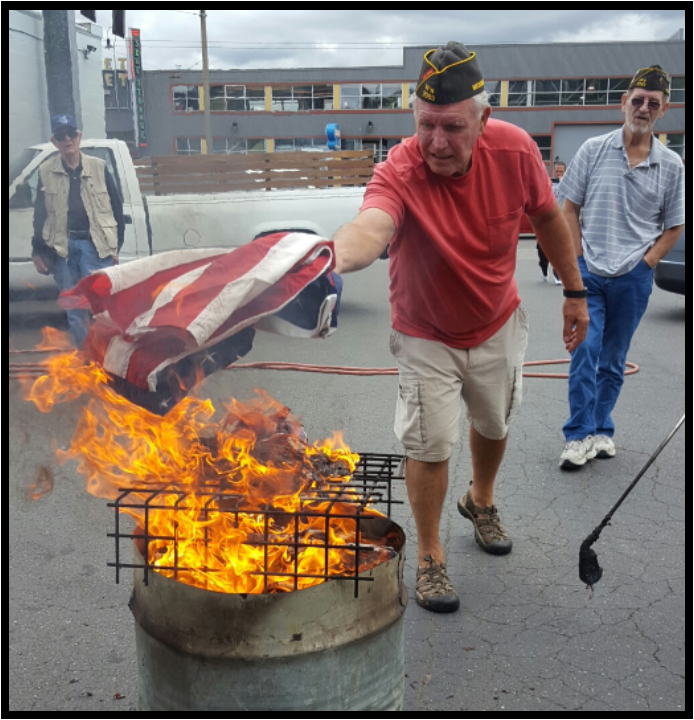 On Flag Day, June 14, 2016, Ballard Eagleson VFW Post 3063 held the first flag retirement service in more than 35 years to dispose properly of worn flags that had been left at the post.
 s Flag Code. The incinerator device was home-made by our Quartermaster Harold Rodenberger from half of a 55-gallon drum mounted on a piece of salvaged aluminum from an old post sign with wheels added for portability. A raised grating supported the flags, while a healthy bed of burning wood provided the fuel.
 as individual freedom still came from there—going all the way back to the Magna Carta in 1215. Does anything remain of these ideals today? Among a fairly significant part of the population, very few it seems. In the U.K. most of the “Great Charter” clauses have been repealed or modified into non-existence for all practical purposes. The basic concept of a right to defend yourself has been written out of the law and bred out of the belief system of most people in that country. Look at this advice from a UK police